Greenland's Vanishing X: A Letter Erased by Climate
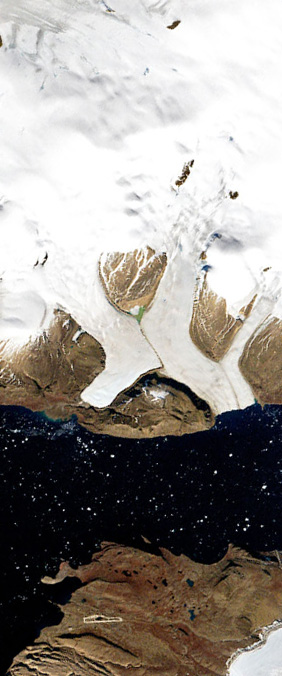
In northwest Greenland, three glaciers converge into Wolstenholme Fjord, their flow lines crossing in a pale, wind-scrubbed X. Landsat has watched this place for fifty years; in that time the ice front has retreated 2.5 km. It is, quietly, a letter erasing itself — an alphabet held hostage by the climate.
The Greenland Ice Sheet
The Greenland Ice Sheet is the second-largest body of ice on Earth, after Antarctica. It covers 1.7 million square kilometers and contains enough frozen water to raise global sea levels by 7 meters if it were to melt completely. Since the 1990s, the sheet has been losing ice at an accelerating rate.
Wolstenholme Fjord is a sentinel for these changes. The glaciers that feed it — Humboldt, Steensby, and others — are among the most active in Greenland. Their flow lines create the X pattern that Landsat photographed in 1972, and that same pattern is now visibly distorted as the glaciers thin and retreat.
A Warning in the Alphabet
Of the 71 letterforms in our Landsat alphabet, several are threatened by climate change. The X in Greenland. The E in Iceland's retreating glaciers. The O of Crater Lake, safe for now inside its caldera but surrounded by increasingly fire-prone forest. These letters are not just curiosities — they are records of a planet in transition, written in ice and stone, visible from space.